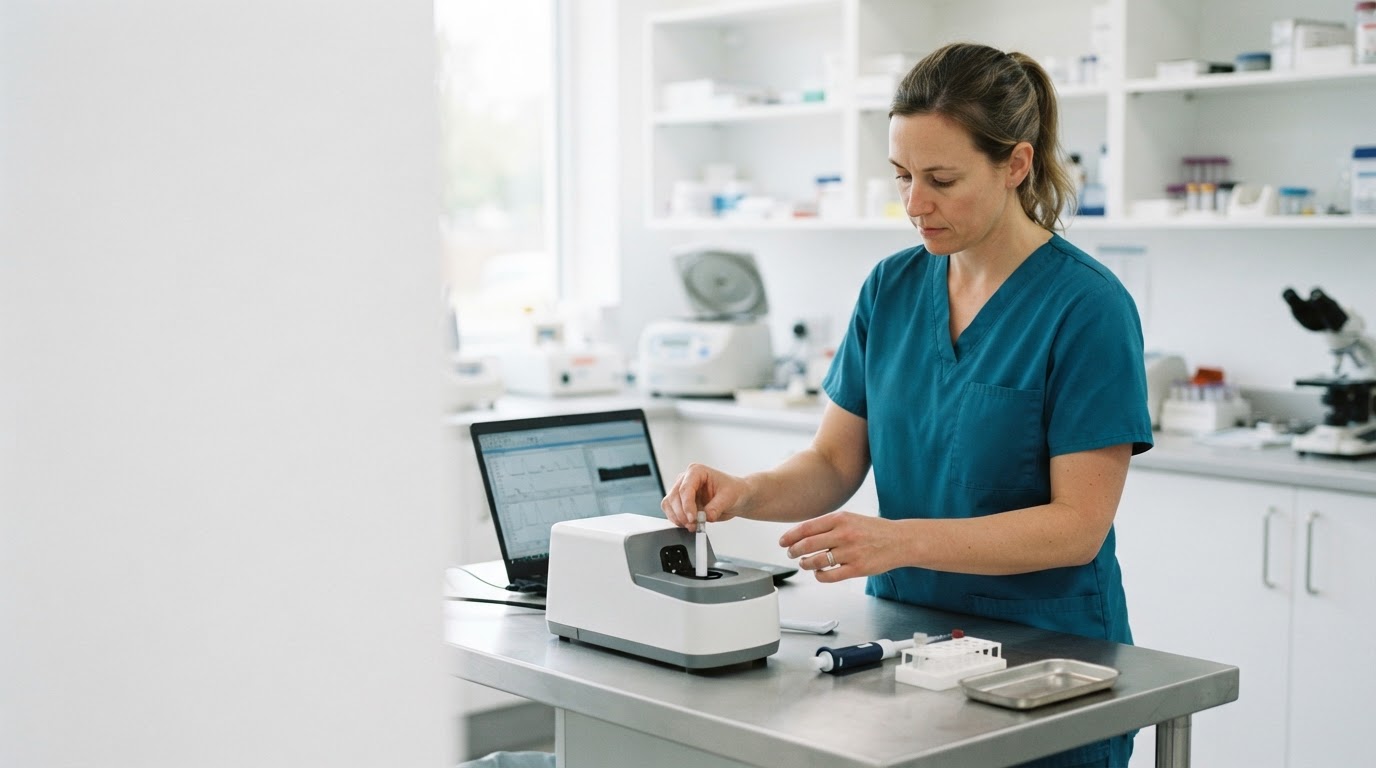
Veterinary Lab Integration: How It Works and Why It Matters
Veterinary lab integration connects in-house analysers and reference laboratories to the practice system so results arrive on the patient record automatically. It removes manual transcription, which is where errors enter the clinical record, and it makes results trendable over time instead of trapped in PDFs nobody can compare.
Veterinary lab integration means your analysers and reference laboratories send results directly into the practice system, attached to the right patient, without anyone retyping them. It sounds administrative. It is actually one of the clearest clinical safety improvements available to a practice.
What it removes from the working day
Transcription. Someone reading numbers from one screen and typing them into another is slow, and it is where errors enter the clinical record. A misplaced decimal in a potassium result is not a clerical matter.
Chasing. Without integration, somebody checks a portal periodically to see whether results have arrived. With it, they appear and can notify the vet who requested them.
Filing. PDFs saved to a shared drive, or printed and scanned, are findable in principle and unfindable in practice six months later.
Why trendability is the real gain
This is the part that is underappreciated. A result stored as a PDF is a picture of a number. A result stored as data is a number you can plot.
Creeping kidney values in an older cat are obvious on a graph across four visits and genuinely easy to miss when each visit is a separate document. Integration is what makes the first version possible, and it changes what you notice rather than merely how fast you work.
In-house analysers versus reference labs
In-house analysers usually connect over the practice network. The result appears within minutes of the run completing. The main things to check are whether your analyser models are supported and whether the connection is bidirectional, meaning you can send the request to the analyser rather than keying patient details at the machine.
Reference laboratories connect over the internet. The important detail is matching: the lab must be able to identify which patient a result belongs to, which depends on requests being raised in the system rather than written on a form. Where results arrive unmatched, somebody has to assign them manually, and that is the step that quietly reintroduces the work you were trying to remove.
What should you check before connecting?
- Which specific analyser models and which labs are supported today, not on the roadmap.
- Is the connection bidirectional, or results-only?
- How are results matched to patients, and what happens when matching fails?
- Are results stored as discrete values that can be trended, or only as attached documents?
- Who is notified when a result arrives, and can that be the requesting vet?
- Is there a charge per result or per connection?
The fourth question is the one most often skipped and most often regretted. An integration that files PDFs neatly is a filing improvement, not a clinical one.
What it costs, and what it saves
Charging models vary. Some labs provide the connection free because it increases the volume they receive, some practice systems charge per connection, and a few charge per result, which is worth establishing before you commit.
Against that, estimate the time honestly. A practice running thirty results a day, each taking two or three minutes to download, match, file and flag, is spending over an hour a day on work that produces nothing. That is the comparison, and it usually settles the question quickly.
Where integrations break
Three common failures, all mundane.
Requests raised outside the system. If a sample goes off with a handwritten form, the result has nothing to match against. Discipline here is what makes the rest work.
Patient records that do not match. Duplicate client records, inconsistent naming, or a patient registered at one site and sampled at another.
Nobody owning unmatched results. There will always be a few. If no one checks that queue daily, results sit unseen, which is worse than having no integration at all because everyone assumes it is handled.
For how this fits with the rest of the stack, see types of veterinary software, and veterinary SOAP notes for where results land in the record.
To see lab results arriving against live patient records, book a demo and bring the analysers and labs you actually use.

